
Searching for Pakistani matrimonial services in the USA usually starts with a Google search. It ends with a dozen open tabs — free apps, paid bureaus, community WhatsApp groups, and matrimonial sites that all promise “verified” matches. Most of what you’ll find skips the actual problems families run into once they start using these services: fake profiles, a Pakistani community too small (or too connected) to search locally, and no reliable way to vet someone thousands of miles away in Pakistan.
This guide covers what goes wrong, what to check before you hand over your family’s information, and how to spot a genuine matchmaking service versus a listing site pretending to be one.
Fake Profiles Are the Biggest Risk on Free Rishta Apps and Sites
The single biggest complaint about free matrimonial sites in the USA for Pakistani users is fake or inactive profiles — accounts created out of curiosity, by relatives testing the app, or by people using the platform for casual conversation instead of marriage.
This happens for a structural reason, not bad luck. Free platforms make money from volume — ad views, sign-ups, app downloads — not from successful matches. There’s little business incentive to remove a profile just because it’s inactive or dishonest, as long as it keeps the user count up. That’s very different from a paid or personally-run matchmaking service, where a fake or non-serious profile is a direct threat to the service’s reputation and has to be caught early.
Common warning signs worth knowing before you trust any profile: photos that look professionally shot or reverse-image-search to unrelated accounts, a bio that’s vague on family background or current location, and a match who avoids video calls or phone conversations in favor of text-only messaging for weeks. If you’re weighing options based in Pakistan specifically, our guide on avoiding rishta scams covers the identity-verification side in more depth.
Why the Pakistani Muslim Community in Many US Cities Is Too Small to Search Locally
Even in cities with a sizable Pakistani population, the number of unmarried, marriage-ready Pakistani Muslims in a specific age range and background is usually small enough that most families exhaust their local options within months.
Community size cuts both ways. In large hubs like New York, Houston, or Chicago, families have more local options — but also more concern about privacy, since a search inside a large, connected community still travels fast through the same mosque circles and family friend networks. In smaller cities or states with few Pakistani families, the problem flips entirely: there may be almost no suitable local matches at all.
This is the practical reason so many families move away from relying on relatives, mosque connections, or local community events, and start looking at matchmaker in USA services with a nationwide reach instead of a single-city pool.
The Privacy Problem: Searching for a Rishta Without Everyone Finding Out
In tight-knit Pakistani communities, families often hesitate to use visible, public-facing rishta platforms because the search itself becomes community knowledge before a match is even found.
This risk isn’t evenly distributed. A woman’s family searching for a rishta typically faces more scrutiny and gossip risk than a man’s family does if the search becomes visible and doesn’t lead anywhere. Community WhatsApp groups make this worse — a profile or a family’s situation can circulate well beyond the people who were actually supposed to see it, sometimes attached to inaccurate details.
This is exactly why confidential handling matters more in this specific context than it would for a general dating app: it’s not just about the individual’s comfort; it’s about protecting the family’s standing while the search is still in progress and unresolved.
The Real Gap Between US-Raised and Pakistan-Raised Expectations
A shared faith and Pakistani background do not guarantee a compatible marriage. The biggest mismatch families report is between someone raised in the USA and someone raised in Pakistan, even when both are practicing Muslims from similar family backgrounds.
A biodata can list religion, sect, education, and family status accurately and still miss the things that actually determine day-to-day compatibility: expectations around dual-income households versus a single-earner family, where the couple will live relative to in-laws, how much autonomy each partner expects in career and financial decisions, and how “family involvement” is defined in daily life versus only during major decisions.
None of this shows up on paper. It surfaces in conversation, and usually only after several direct discussions rather than a single introductory call — which is why families searching seriously need a process built around actual compatibility screening, not just paperwork matching.
How to Vet a Match From Thousands of Miles Away
When a US-based family is considering a match based in Pakistan, verifying identity, family background, and genuine intent becomes far harder without in-person contact — and this is exactly where families are most often deceived.
A few practical checks before trusting a match based in Pakistan:
- Insist on a video call early, not just photos and text. Someone avoiding this for weeks is a red flag, not a cultural quirk.
- Ask for a recent, unedited photo taken specifically for you, along with basic ID confirmation.
- Get a reference from someone known to both families — not just a relative of the other side, who has an obvious reason to vouch for them.
- Be cautious of urgency. A match or their family pushing for a fast decision, especially around finances or visa timing, is one of the most consistent patterns in matrimonial scams involving overseas Pakistanis.
- Consider a service that verifies independently, rather than one that simply relays whatever the other family claims about themselves.
“The families who skip the video-call step are consistently the ones who run into problems later. It’s the step people are most tempted to shortcut when they’re excited about a profile — and it’s also the one that catches the most red flags.” — Huma Khalid, Founder & CEO, HK Matrimony”
Career Timelines vs. Family Pressure: A Diaspora-Specific Tension
Many US-raised Pakistani professionals marry later than their parents expected — not from lack of interest, but because US education and career timelines push a serious search into the late twenties or early thirties.
Medical residencies, PhD programs, and early-career demands in competitive US industries simply don’t align with the marriage timelines common in Pakistan. This creates friction that’s rarely acknowledged directly: parents comparing their US-based child’s unmarried status to cousins back home who married years earlier, without accounting for the different professional path that delayed it.
A matchmaking approach that understands this timeline — and doesn’t treat every unmarried 28- or 30-year-old professional as “behind” — tends to serve US-based Pakistani families far better than one built around Pakistan-based marriage norms. This isn’t unique to the diaspora either; we’ve covered the broader shift in our piece on the late marriage trend among Gen Z more generally.
Free vs. Paid Pakistani Matrimonial Services in the USA — What’s the Real Difference? 
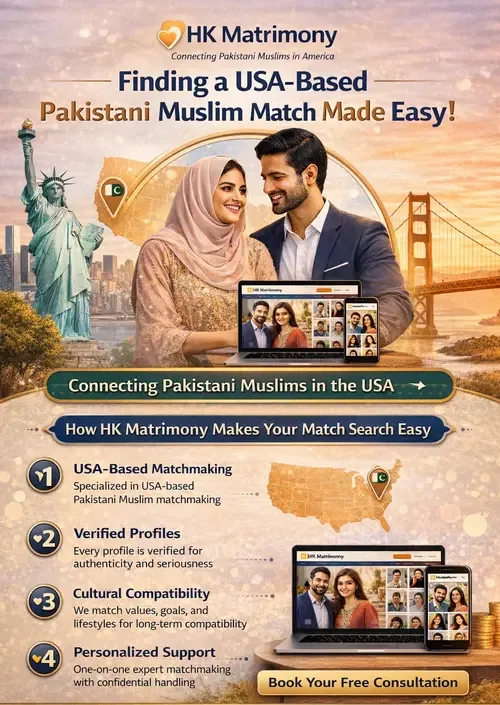
Free Pakistani matrimonial sites give you unlimited browsing at no cost, but little to no verification, no personal matchmaking guidance, and no real accountability if a profile turns out to be fake. Paid matrimonial services typically add profile verification, a personal consultant who filters matches against your stated preferences, and a level of accountability the platform has a direct business reason to maintain.
Neither option is automatically “better” — it depends on where you are in the process. A free platform can make sense for early, casual browsing when you’re not ready to commit time or money yet. A paid, personally-guided service makes more sense once you’re serious and want someone actively filtering out the profiles that waste your time or put your family at risk. If you’re evaluating what a guided service actually involves day to day, our matchmaking process page walks through each step.
Pricing varies widely between providers and the level of service included, so ask any paid service for a clear breakdown of what’s covered — verification, number of introductions, ongoing consultant support — before committing to anything. For a closer look at how verified matchmaking stacks up against free listings specifically, see our breakdown of verified matchmaking vs. free listings.
Cross-Border Marriage: What to Know About Visas and Immigration Before You Start
If a serious match is based in Pakistan rather than the USA, the process doesn’t end with an engagement — it involves a separate spousal visa process that can take months, and understanding it early prevents a lot of avoidable stress later.
Families often start the matrimonial search without researching this side at all, then discover months in that the visa timeline affects wedding planning, travel, and even where the couple will live in the first year of marriage. If a cross-border match is a real possibility for your family, it’s worth reading through the process in advance — see our full spousal visa guide for what’s actually involved.
The Bottom Line
Choosing between Pakistani matrimonial services in the USA isn’t really about which app has the most profiles — it’s about verification, privacy, and whether the service actually understands the specific challenges of a US-based, cross-border search. Fake profiles, community-size limits, and the US-raised versus Pakistan-raised expectations gap are the real obstacles, and no platform’s marketing page will mention them upfront.
HK Matrimony has been matching Pakistani families in the USA since 2017, with more than 500 successful matches to date. If you’re ready to move from research to an actual, guided search, our Pakistani rishta service in the USA handles verification, matching, and family coordination directly.