 Skip to content
Is Your Spouse Ready for a U.S. Visa? The Pakistani Immigrant’s Guide to Immigration Success!
As a Pakistani immigrant in the U.S., one of the most important steps in building a life with your spouse is understanding the process of bringing them into the U.S. If your spouse is residing outside the U.S., you’ll need to navigate the U.S. spousal visa process. This guide is designed to help you understand the step-by-step process to successfully bring your spouse from Pakistan or any other country to the U.S., ensuring a smooth and legally compliant immigration journey.
In this article, we’ll break down everything you need to know, from the initial petition to the final stages of consular processing, providing you with actionable insights to make your process as efficient and stress-free as possible.
Understanding the U.S. Immigration Process for Pakistani Immigrants
When you, as a Pakistani immigrant in the U.S., want to bring your spouse from abroad, understanding the spousal visa process is crucial. The U.S. government has established a legal path for citizens and legal permanent residents to sponsor their foreign spouses for a U.S. visa, but it is a multi-step process with important documents and procedures.
For a Pakistani immigrant, the two primary options for sponsoring your spouse are the CR-1/IR-1 Marriage Visa and the K-3 Visa, each serving different circumstances.
A. CR-1/IR-1 Marriage Visa (For Married Couples)
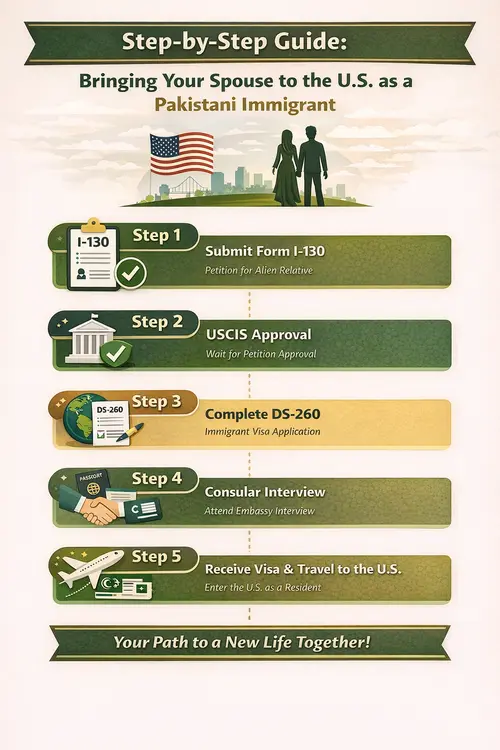
If you are already married and your spouse is abroad, you will apply for the CR-1/IR-1 Marriage Visa. This process involves filing a Form I-130 (Petition for Alien Relative), which establishes that your spouse is your family member and is eligible for U.S. immigration. After the petition is approved, your spouse will undergo consular processing at the U.S. embassy in their home country (or nearest U.S. consulate).
B. K-3 Visa (For Spouses Awaiting I-130 Approval)
The K-3 Visa is designed for couples who are already married but need to wait for the I-130 petition approval before their spouse can enter the U.S. This visa allows the spouse to come to the U.S. while waiting for permanent residency status. It’s important to note that not all couples need a K-3 visa, as many may simply apply for the CR-1/IR-1 visa.
How to Initiate the Process: Essential Forms and Procedures
Once you’ve chosen the correct visa type (CR-1/IR-1 or K-3), the first step is filing the Form I-130 (Petition for Alien Relative). This petition is submitted by the U.S. citizen or permanent resident spouse. It establishes your relationship and kicks off the process of your spouse receiving a U.S. visa.
Key Forms for the Spousal Visa Process
- Form I-130: The first form you need to file if you are already married to your spouse. This form establishes your relationship with your spouse.
- Form I-864 (Affidavit of Support): This form must be filed by the U.S. citizen spouse, proving they can financially support their spouse once they arrive in the U.S.
- Form DS-260 (Immigrant Visa and Alien Registration Application): Once the petition is approved, your spouse must complete this form as part of consular processing.
Each of these forms will require supporting documents to validate the marriage and ensure the legitimacy of the relationship, such as:
- Marriage certificates
- Proof of communication (emails, text messages, and phone logs)
Joint bank accounts, bills, or other shared financial documents
Consular Processing: Bringing Your Spouse to the U.S.
After your Form I-130 is approved, the next step is consular processing. This stage involves your spouse applying for their immigrant visa at the nearest U.S. embassy or consulate in their home country (or the nearest U.S. consulate). Here’s what happens in this phase:
A. The Interview Process
Your spouse will be required to attend an interview at the U.S. embassy or consulate. During this interview, they will need to present supporting documentation such as:
- Valid passport
- Police clearance certificate
- Medical examination results (a mandatory health checkup by an authorized physician)
- Financial evidence proving that you, as the sponsor, meet the minimum income requirements
The consular officer will assess the documents and may ask questions to ensure the marriage is genuine and not based solely on immigration purposes.
B. Visa Approval and Entry into the U.S.
Once the interview is successful and the visa is approved, your spouse will be issued an immigrant visa. They can then travel to the U.S. and, upon arrival, become a permanent resident of the U.S. through adjustment of status.
Key Challenges for Pakistani Immigrant Navigating the Spousal Visa Process
A. Visa Delays and Backlogs
The spousal visa process can be slow, and delays are common due to high demand and consular processing backlogs. Processing times for visas can vary depending on the U.S. embassy, the visa category, and the applicant’s home country.
B. Proving a Genuine Marriage
To avoid delays or complications, you must provide solid proof that your marriage is legitimate. U.S. immigration authorities are very thorough in reviewing marriage-based petitions and require clear evidence of a genuine relationship. This includes:
- Photos, texts, and call logs showing communication over time
- Proof of joint bank accounts, property, and other shared assets
- Statements from friends and family confirming your relationship
C. Emotional and Cultural Barriers
For many Pakistani immigrants, emotional and cultural challenges arise when trying to communicate with their spouse during the immigration process. The waiting period, distance, and lack of direct family involvement can create frustration and emotional strain. It’s important to communicate openly and understand that the process requires patience.
Common Misconceptions About the U.S. Spousal Visa Process
1. “You can only apply for a spousal visa if your spouse is in the U.S.”
- Reality: This is incorrect. If your spouse is living outside the U.S., you can still sponsor them for a visa through consular processing at a U.S. embassy in their home country or country of residence.
2. “The spousal visa process will take only a few months.”
- Reality: Spousal visa processing can take several months or even over a year due to various factors like visa backlogs, the complexity of the case, and country-specific delays. It’s important to be patient and stay informed about processing times.
3. “You don’t need to prove the marriage is legitimate if you’ve been married for years.”
- Reality: Regardless of how long you’ve been married, you must provide substantial proof that your marriage is genuine. This includes photographs, communication records, and financial documents. Fraudulent marriages are heavily penalized by U.S. immigration authorities.
4. “A spousal visa guarantees permanent residency automatically.”
- Reality: While the spousal visa allows your spouse to enter the U.S., they must still complete the Adjustment of Status process once they arrive. Only after successfully adjusting their status will they be granted a green card and permanent residency.
Local or Regional Considerations for Pakistani Immigrants
If you are living in areas like New York, California, or Chicago, where there are large Pakistani communities, you may find local resources and support networks that can help streamline your immigration journey.
A. Community-Based Support
In areas with a high population of Pakistani immigrants, there are local organizations that offer support, including legal guidance, cultural integration services, and community outreach. These organizations can help you find local immigration lawyers who specialize in family-based immigration.
B. Pakistani-American Associations and Networking
Many Pakistani-American associations in the U.S. guide family-based immigration, and networking with other members who have gone through the process can offer valuable insights.
Start Your Journey with HK Matrimony
Are you a Pakistani immigrant in the U.S. looking for a compatible life partner? HK Matrimony specializes in connecting Pakistani Muslims worldwide through trusted matrimonial platforms. Begin your search today and ensure compatibility both culturally and legally.
Visit our Pakistani Rishta in USA page to find the best matrimonial matches, and reach out to us for personalized assistance. Our team is here to help you every step of the way.
For tips on connecting with Muslim life partners and navigating cultural considerations, check out our guide on Finding a Muslim Life Partner in the USA.
If you have already chosen your partner and are planning your wedding, our Traditional Pakistani Wedding in the USA guide will help you organize a memorable event that beautifully blends cultural traditions with modern celebrations.
Conclusion: Successfully Bringing Your Spouse to the U.S.
Bringing your spouse to the U.S. as a Pakistani immigrant requires careful attention to legal details, but it’s a rewarding process. By understanding the visa options, gathering the necessary documentation, and working with a qualified immigration lawyer, you can ensure a smooth journey for your spouse’s immigration.
Consult with an experienced Pakistani immigration lawyer to ensure that your case is handled with professionalism and care. Their expertise will guide you through the intricacies of U.S. immigration laws, helping you avoid common mistakes and delays.
FAQs
Q1: Are there online platforms for Pakistani immigrants to connect for marriage in the U.S.?
Yes, platforms like HK Matrimony allow Pakistani immigrants to connect with potential matches in the U.S. and worldwide. These platforms facilitate culturally respectful matchmaking, often with the option of verifying profiles and maintaining privacy.
Q2: What are the average legal fees for obtaining a Pakistani immigrant spouse visa?
The legal fees for spousal visas can vary depending on the attorney and case complexity. On average, fees can range from $1,500 to $5,000 for spousal petition filings and related services. Additional costs may include filing fees and medical examinations.
Q3: How do I start the application process for a spouse visa for my Pakistani partner?
To start the spouse visa application process, you must file Form I-130 (Petition for Alien Relative) for your spouse. This is the first step in the immigration process for spouses. If you’re in the U.S., you can also file for an Adjustment of Status after marriage.
Q4: What are the eligibility requirements for a Pakistani immigrant spouse visa to the U.S.?
The basic eligibility requirements include:
- The U.S. citizen or permanent resident spouse must be able to prove their relationship with the applicant.
- The sponsoring spouse must meet certain income requirements to ensure they can support their spouse financially.
- Both parties must be legally eligible to marry, and the marriage must be genuine.
Q5: Can my Pakistani spouse apply for a visa if they are living in a third country?
- Yes, your spouse can apply for a visa at the nearest U.S. consulate or embassy, even if they are not living in Pakistan. However, they must meet the same requirements and undergo consular processing.
Q6: How much financial support must I show to sponsor my spouse?
- You must demonstrate that you have sufficient income to support your spouse once they arrive in the U.S. The minimum income requirement is based on the Federal Poverty Guidelines.
Q7: How long does the consular processing take for Pakistani immigrants?
Consular processing can take anywhere from 6 months to over a year, depending on factors like visa type, embassy processing times, and other delays.



Leave A Comment